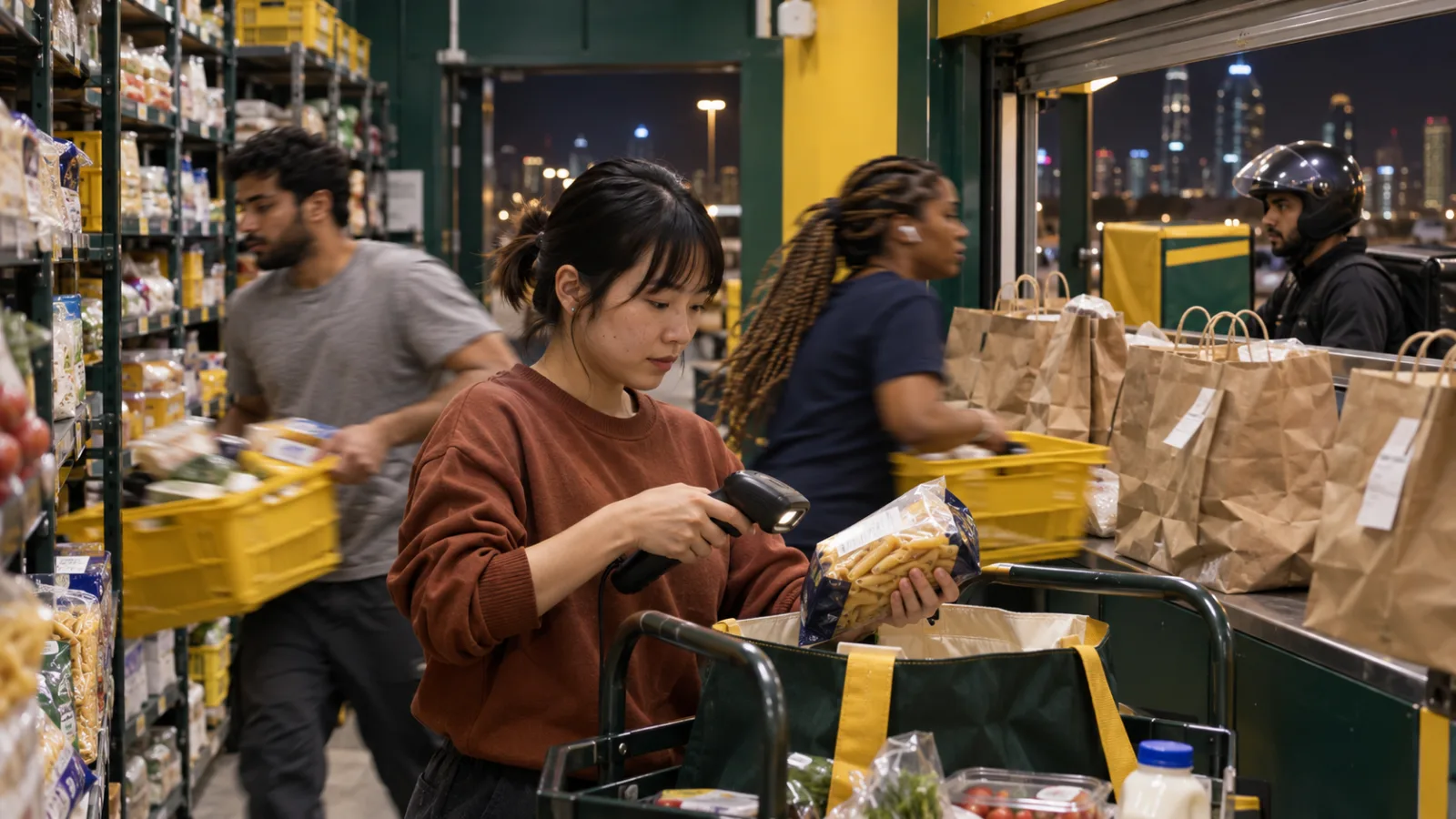
Every order has a par in the dark store.
Your stores are open, your riders are out, and the month still ends short. We follow one order through your dark store, find what it really earns you, and close the gap.
Where one order's money goes
A sample order through a dark store: stocked, picked, slotted and delivered. Every figure is a sample. Yours come from your own files.
- What the order earns you7.000
- Goods sold4.800
- Fresh food written off0.260
- Picking0.330
- Rider time on the drop0.500
- Delivery slots that leave half full0.150
- Store rent and running costs0.420
- Refills into the store0.220
- Lost lines and refunds0.100
- What you keep0.220
Seven units, one number each
Each unit the order passes through has one number that tells you how it is doing. A sample operator, read the way we read you.
Sample
- Stock
Stock record accuracy
YOU 93%PAR 98%
Your screen says three on the shelf and the shelf holds none. Your customer pays for an item you cannot send.
- Shelf
Lines picked in full, no substitution
YOU 88%PAR 96%
Each substitution is a smaller basket or a refund. You paid for the picker and the rider either way.
- Picker
Lines picked per hour
YOU 92PAR 125
Every extra minute per order is labour you cannot bill. The layout of your dark store decides it, long before the picker does.
- Slot
Orders per delivery slot
YOU 5.2PAR 7.5
A slot that leaves half empty costs you the same rider. Your promise is sold by the clock and paid for by the load.
- Rider
Orders per rider hour
YOU 1.9PAR 2.6
Between peaks your riders wait outside the store on your payroll. Those hours sit inside the cost of every order.
- Waste
Fresh food written off, share of fresh sales
YOU 6.5%PAR 3.5%
Fresh food you bought and could not sell goes in the bin at cost. A wide range in a small store makes it worse.
- Refill
Refill cost, share of order value
YOU 3.1%PAR 2.2%
Each refill run brings stock in at the price of a truck and a crew. Too many small runs and the cost lands on every order.
More of the order is the store's own stock
14.8%
talabat's own grocery and other income reached 14.8% of its gross merchandise value in the second quarter, up from 12.4% a year earlier. talabat said its revenue grew faster than its order value, driven mainly by a higher share of talabat mart.
Source: talabat Holding plc, Q2 and H1 2026 results press release, 12 August 2026. From our Moneyball Finance research.
Three moves, in this order
Bring last month
Stock records, pick logs, rider and slot reports, refill invoices, waste logs and bank statements, as they are. One sitting at your table.
Get your score
One page with your numbers beside your par, unit by unit, and the places the difference goes.
Close the biggest leak
We fix the largest one first, then we score you again every month.
How we close the gap
We fix your stock record
Your screen and your shelf agree. You stop selling items you cannot send, and your refunds fall.
We cut your waste
Your fresh range is ordered to what each store sells. You write off less of what you bought.
We set riders and slots to demand
You pay for the hours your orders arrive. Rider hours that wait fall, and each slot leaves fuller.
We reset the refill rhythm
Fewer, fuller runs into each store, at a cost per order you know.
On your desk
- One order priced through the dark store, for each of your stores.
- A profit statement, store by store.
- A stock and waste plan for your fresh range.
- A rider and slot plan that matches your peaks.
- Your score every month, unit by unit.
What owners ask us
- How do I know which of my dark stores lose money?
- Price each one on its own. We set what an order earns you in each store against its stock, picking, riders, waste, refills and rent, and you see each store's profit on one page.
- How many orders per rider hour should a dark store reach?
- As many as your peaks allow, with no rider hours spent waiting. We read your order times against your rider hours, store by store, and size the riders to the load. Our fleet profitability work shows how.
- Why does my dark store write off so much fresh food?
- Because the range is wider than the store sells through. We read every fresh line's sales against what you order, and cut the lines that spoil first.
- Do you work with one dark store, or only networks?
- Both. One store or forty, we price one order, find the largest leak and fix it first.
We know the dark store and the street
Our founder set the money logic behind a last-mile fleet of about 1,000 vehicles at BaladiMart, part of Al Baladi Group, and has spent years in Doha working with grocery and quick commerce. We read your operation the way you run it, by the order, the shelf and the day the cash lands.
Related
- Network & Fleet StrategyWhether you own, lease or partner for delivery, and how your network turns a profit.
- Fleet profitabilityWhat each vehicle earns you in a day, and whether to lease, own or outsource.
- Who keeps the value of a 6 pm delivery window?Agents will book delivery ahead of time. Whether the notice reaches the fleet, and who keeps the saving, is a question of position on the Control Matrix.
Bring last month. Leave with a score.
Sit down with Qasim Abbas. One table, your numbers, and a clear read on where you stand against par.