What a dark store commits before the agent orders
Our management consultants tell grocery boards in Bahrain, the UAE, Qatar, Saudi Arabia, Oman and Kuwait that a dark store commits cash and capacity before any customer orders. When an outside agent chooses the basket, the influence over demand moves; the stock, the payroll and the supplier payment dates do not.
Commitments made before the order
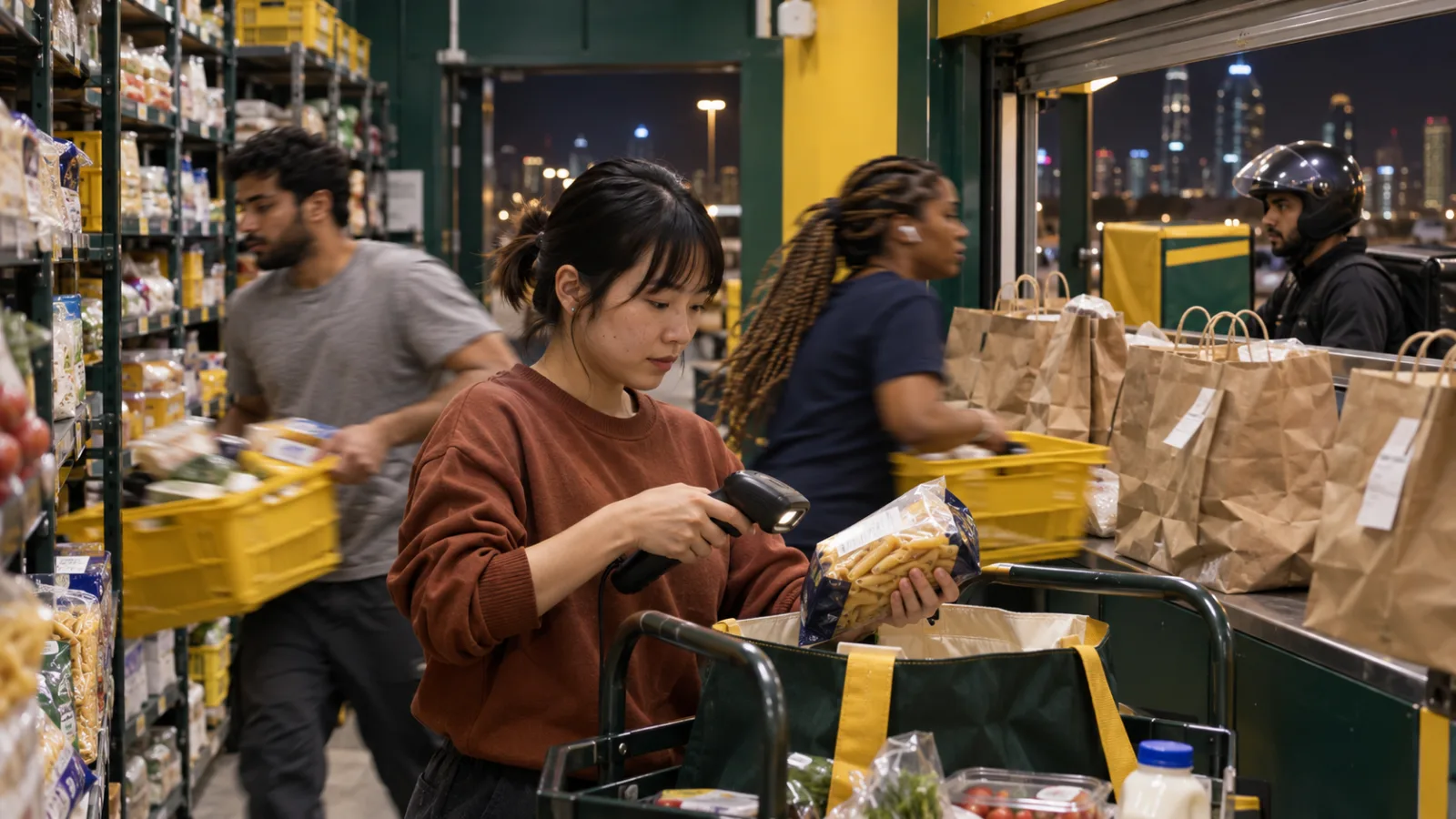
Before a customer taps anything, a dark store has already committed. It has agreed supplier targets to earn its rebates, bought stock for a funded promotion, taken space for a range, rostered pickers for the evening peak and set the dates it pays suppliers. Together those decisions commit cash and capacity to an expected pattern of demand.
Today the store shapes that demand through its range, prices, promotions and placement. Hand the choice of products and retailer to a household's assistant, and part of that influence moves outside the store.
Outside assistants already place grocery orders
Four assistants
Instacart customers can shop through ChatGPT, Claude, Gemini and Muse. Claude has carried Instacart since 23 April 2026 and Gemini since 19 May 2026. On 21 October 2026 Walmart announced its Agent Gateway for outside agents, beginning with a beta for companies and developers.
Source: Instacart Help Center, read 7 November 2026; Instacart, 23 April and 19 May 2026; Walmart, 21 October 2026.
A bargaining question
That makes the assistant a counterparty. The store brings purchasing power, local availability and fulfilment. The assistant routes orders. Whether it also brings new customers, or useful notice of demand, decides what the relationship is worth to the store.
Supplier terms pay for different things
Supplier terms are the first place we look, because each one pays for something different. Purchase discounts and free units set what it costs to serve the basket. A target rebate rewards qualifying volume, and a missed target costs the rebate. A funded promotion changes the offer itself, and an assistant can still compare it. Visibility fees sell exposure, and an outside assistant decides what it shows.
We expect visibility fees to come under pressure first and target rebates next, because an assistant that routes volume elsewhere can move a store below its targets without anyone in the store deciding it.
Our view
An outside assistant can make a dark store easier to buy from and easier to replace. The operator needs buying terms, reliable availability and fulfilment economics that give it a reason to be chosen beyond simply being connected.
The board's questions
- A Merchant running dark stores should ask which supplier terms depend on volume it steers today through range, price and placement, and what each is worth when an assistant routes that volume.
- A Tenant selling through a platform's dark stores should ask who earns the visibility fees when the shopper never sees a shelf.
- A Carrier should ask whether orders placed by assistants arrive with enough notice to plan the picking and the riders.
- A Sovereign should ask whether to open its own gateway to outside agents on its own terms, as Walmart has begun to, before the assistants set them.
From supplier terms to the agent's choice
We map every supplier term to the volume it depends on, price what moves when an assistant chooses the basket, and renegotiate rebates and funded promotions through Strategic Sourcing & Resilience and Digital, AI & Agentic Commerce.
Sources
- Instacart Help Center, Shop with third-party AI apps, read 7 November 2026.
- Instacart, Instacart is now available in Claude, 23 April 2026; Instacart brings agentic grocery shopping to Gemini, 19 May 2026.
- Walmart, Walmart makes it possible for agents to shop on behalf of customers, 21 October 2026.
- Supplier terms: At Par analysis. Published in Moneyball Finance, 29 October 2026.
Related
- Grocery & quick commerceOne order through your dark store: stock, picking, slots, riders and waste.
- Strategic Sourcing & ResilienceYour sourcing plan, your supplier cover and the money plan for when supply is disrupted.
- Who owns the customer when the agent holds the memory?If the customer's agent holds the order history, the platform no longer owns the start of the next purchase, and verifiable fulfilment counts for more than visibility.
Bring last month. Leave with a score.
Sit down with Qasim Abbas. One table, your numbers, and a clear read on where you stand against par.